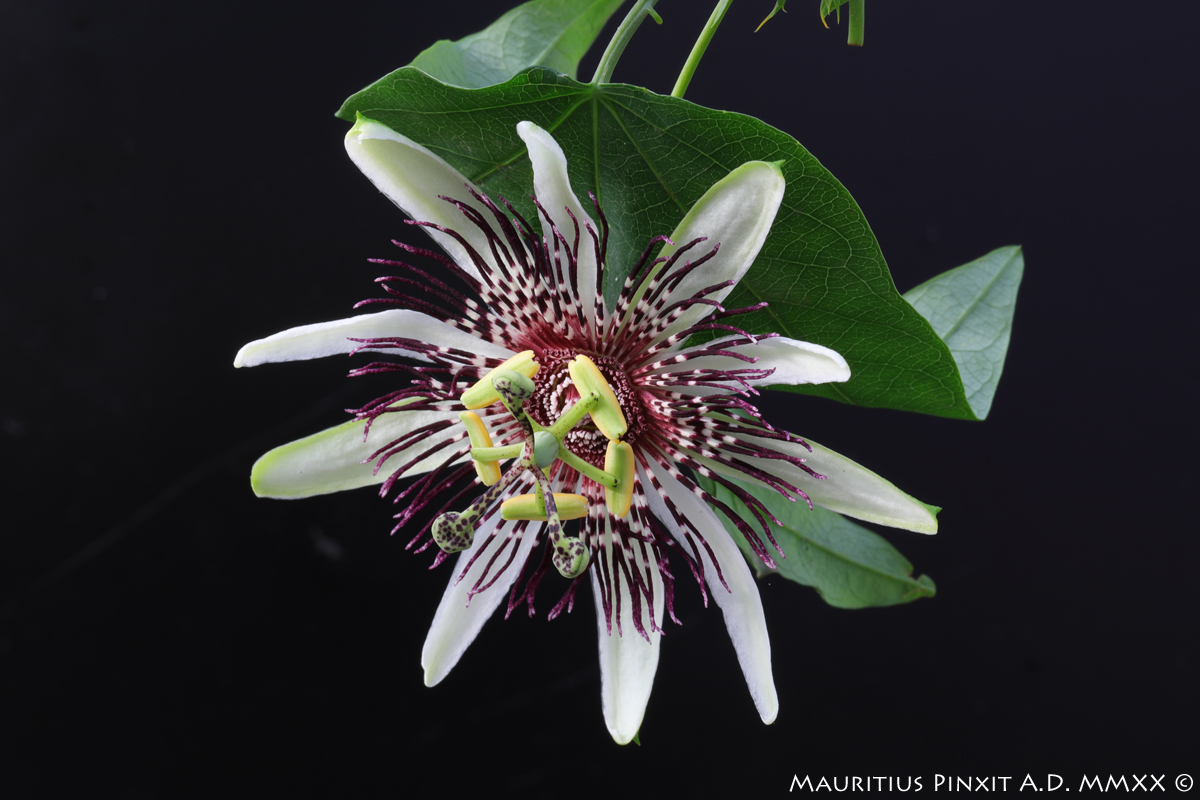
Passiflora trisulca
Masters (1887)


SUBGENUS: passiflora
SUPERSECTION: stipulata
SECTION: granadillastrum
GEOGRAPHICAL DISTRIBUTION OR ORIGIN:
Colombia
CRITICAL MINIMUM TEMPERATURE: 10 °C
IDEAL MINIMUM TEMPERATURE: 12 °C
ETYMOLOGY: From the Latin prefix tri- tre and from súlcus, furrow: with three furrows, referring to the trilobed leaves.
NOTES: Chromosomes: 2n=18.
DESCRIPTION:
Passiflora trisulca grows in Colombia, in regions of the central and southern Cordillera. Killip places it particularly in the department of Cauca.
This species has only recently arrived in Europe and is still present in my collection, where it has flowered several times.
The flower of Passiflora trisulca is distinguished by its essential elegance and by the sharp contrast between the white corolla and the deep violet corona. The sepals and petals, similar in shape and colour, are narrow, lanceolate and slightly curved outwards. Both are of a pure white, sometimes veiled by a faint greenish tint towards the base.
The corona, dense and harmonious, is formed by several series of fine filaments arranged with regularity around the centre. In the lower half, the filaments show alternating bands of dark violet and white, clearly defined and evenly spaced; beyond the midpoint they continue in a uniform, intense purple to the tips. This gradation, combined with the precision of the pattern, gives the flower depth and emphasises its symmetry.
In the past, the species was distributed in Europe under the incorrect name Passiflora lehmanni. It can be distinguished, however, by several features, including the colouring of the corona, which is violet at the base and white towards the tips. The error was noted and corrected by the taxonomist John MacDougal, who clarified the identity of the species once and for all.
The flowers, about six centimetres in diameter, are well proportioned to the plant’s overall habit, which shows slender stems and regular internodes. The trilobed leaves, of a deep and glossy green, are neatly arranged along the stems, giving the plant a clean and balanced appearance.
This is a typically tropical species that adapts well to pot cultivation in containers about twenty-five centimetres in diameter, placed in a bright position but protected from direct sunlight. It prefers shady and cool conditions and, like all Andean species, does not tolerate excessive heat. When temperatures rise above 30 °C, growth slows and part of the foliage may be shed.
During the winter it requires a minimum temperature of around 10 °C. Short drops below this level do not cause permanent damage, but watering should be reduced and fertilisation suspended. Under these conditions the plant enters a light state of dormancy, which helps it recover balance and encourages flowering in the following season.
Propagation by cuttings is easy and fast.