Passiflora rufa
Feuillet (2008)


SUBGENUS: decaloba
SUPERSECTION: auriculata
GEOGRAPHICAL DISTRIBUTION OR ORIGIN:
French Guiana.
CRITICAL MINIMUM TEMPERATURE: 12 °C
IDEAL MINIMUM TEMPERATURE: 15 °C
ETYMOLOGY: From the Latin rufus, red, reddish, colour of the tomentosity of some morphologies of the plant.
DESCRIPTION:
I have encountered this species many times in the wild, along tracks and paths in French Guiana. It occurred in open and bright areas, and the specimens were always in flower and fruiting. I remember discussions with my French friends about the correct identification, whether it was truly Passiflora rufa or rather the related Passiflora ferruginea. The discussion ended with the suspicion, never clarified at the time, that the two names were synonyms. In fact they are not, although there is a strong resemblance, especially in the rusty-coloured tomentosity on the underside of the leaves.
In his 2024 list of recognised species of Passiflora, Yero Kuethe reports both species as valid. Moreover, Passiflora ferruginea is a species described by Masters in 1872 as part of the Peruvian flora, and therefore with a geographical distribution different from that of Passiflora rufa.
The flowers are pale, with a cream-white corolla tending towards greenish tones. The sepals and petals are elongated and slightly reflexed. The corona is bicoloured, arranged in two main series: the outer filaments are straight, with dark purple bands at the base and white with a very light green tint at the slightly undulated tips. The inner series are shorter and often curved towards the centre, with pale tips. The overall appearance remains bright and clean, without vivid colours.
Contrary to what is almost always seen in plants assigned to Subgenus Decaloba, the petiole bears a pair of conspicuous spherical glands, rich in reddish tomentosity and positioned opposite each other.
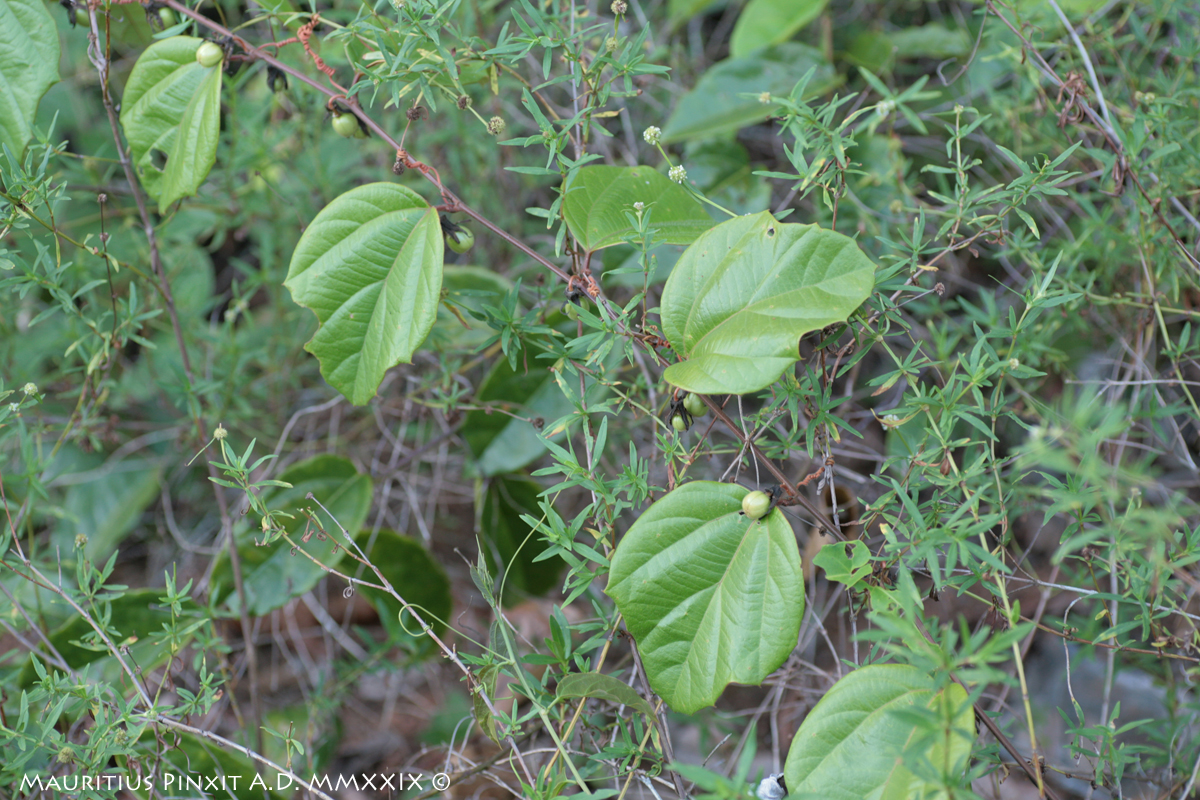
The leaves are entire and broad, rounded in shape, with a full semicircular base and marked veins. The upper surface is glossy green, while the lower surface is covered with rusty-coloured tomentosity, which is also present on the stems. It is precisely this feature that has often led to confusion with Passiflora ferruginea. On closer inspection, the margin of the upper half is not completely smooth: along the secondary veins, small acute angles appear, giving the lamina a slightly incised profile, as if the lateral lobes were only just hinted at and not fully developed.
The fruits, always present, are small spheres that turn brown when ripe.
I have only rarely cultivated this species, because, due to its limited ornamental appeal, it is seldom grown. Moreover, unlike what I have observed in the wild, it proved reluctant to flower.


