Passiflora punicea
Ruiz & Pav. ex DC. (1826)


SUBGENUS: passiflora
SUPERSECTION: distephana
GEOGRAPHICAL DISTRIBUTION OR ORIGIN:
Peru
CRITICAL MINIMUM TEMPERATURE: 10 °C
IDEAL MINIMUM TEMPERATURE: 12 °C
ETYMOLOGY: it derives from the Latin puniceus, meaning “red-purple”, a term which in turn goes back to Greek and indicates the “red-purple colour”, from φοῖνιξ (phóinix), “purple”.
DESCRIPTION:
Passiflora punicea Ruiz & Pav. ex DC. was first described in 1828. A few years ago it arrived in Europe and began to circulate in collections, although its true name remained a mystery. We only knew that it was considered part of the Distephana group and that it came from Peru.
Everything remained the same until someone decided to tackle the matter seriously and finally give it a precise identity, identifying it as Passiflora punicea. From that moment on, we were all very pleased to update our labels, removing the generic “Passiflora Distephana Peru” entry and replacing it with the correct denomination. A real relief, because an uncertain name always ends up spoiling the pleasure of cultivation.
John Vanderplank, curator of the British National Collection of Passiflora, resolved the dilemma with an article published in March 2020 in Curtis’s Botanical Magazine, volume 36, issue 1. In the text, in addition to the accurate description of the species, it is clarified that the name Passiflora punicea, long treated as a simple synonym of Passiflora vitifolia, actually belongs to a distinct species, this one.
The species is native to Peru, as indicated in the historical description and confirmed in more recent publications. At present, information on its distribution in the wild is still limited, and detailed data on its specific habitat are not available.
Not only that, but Vanderplank classified this species within Subgenus Coccinea, thus giving it a new taxonomic placement compared to what had previously been hypothesised for the Distephana group. In the same article he also published the keys for distinguishing the species assigned to the two similar subgenera.
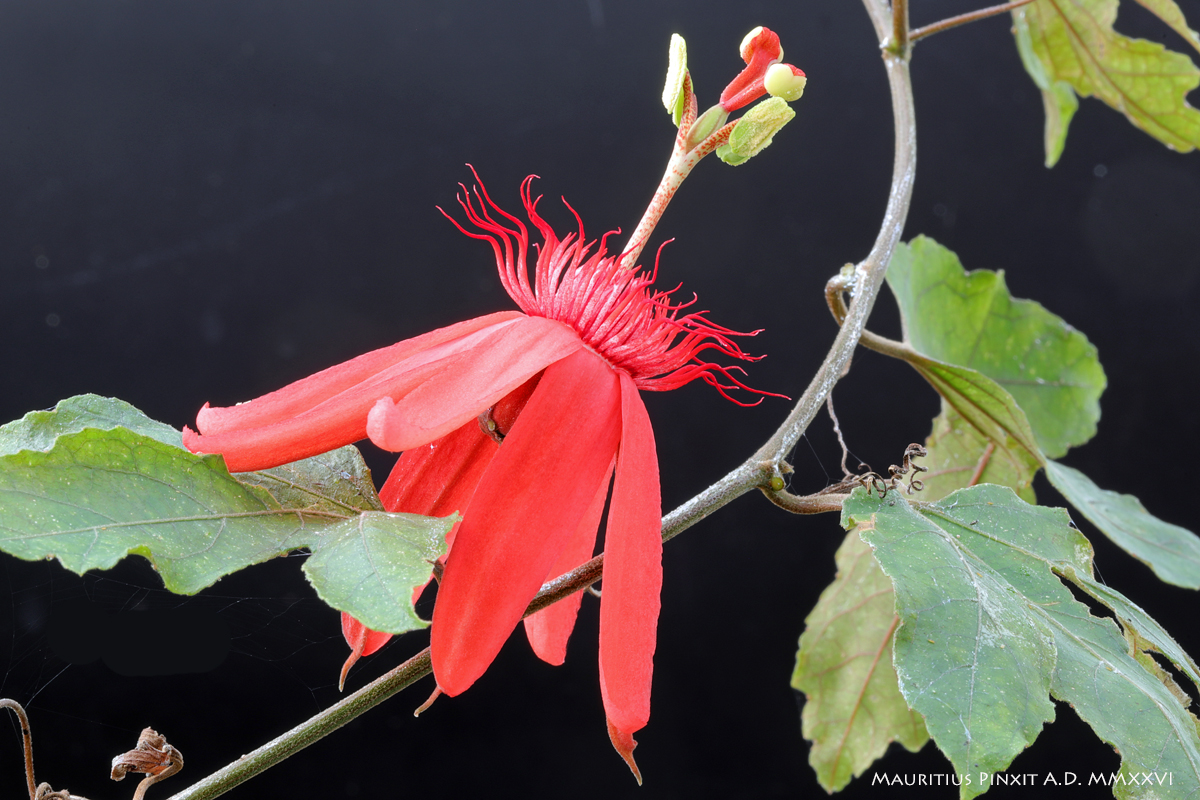
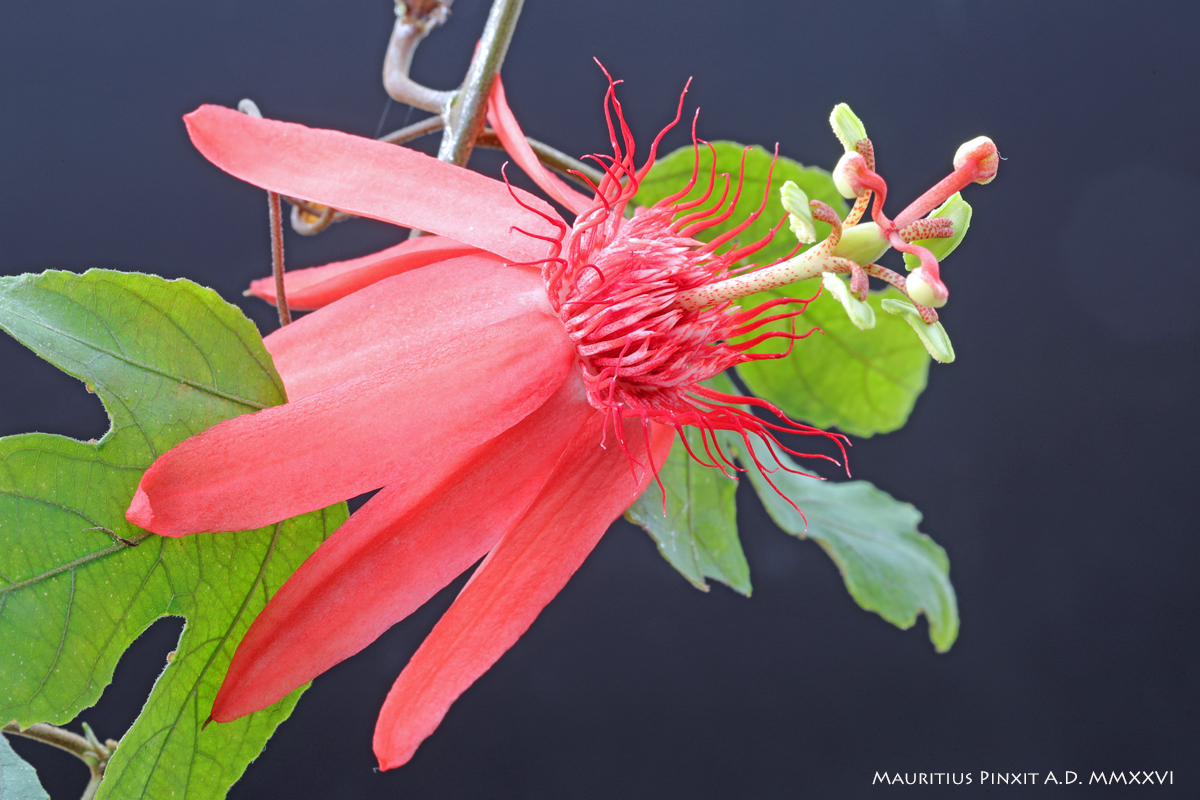
It belongs to a group of plants that unhesitatingly favours bright scarlet red as the dominant colour of its flowers. The corolla is red, and so is the corona, formed by short, erect filaments that take on a slightly darker shade. No other colour appears: it is an absolute red, intense and immediate.
The flower reaches a diameter of around ten centimetres, with petals and sepals of a vivid scarlet red. The plant has a vigorous habit, with stems that in nature can reach up to fifteen metres in length. Even the shape of the leaves recalls that of Passiflora vitifolia: distinctly trilobed, with well-defined lobes and deep sinuses. The affinity between the two species is evident at first glance. The fruits are equally ornamental, marked by six vertical bands of white speckles that stand out against the green surface. This is another feature that brings them close to the fruits of Passiflora vitifolia.
In cultivation it proves to be a generous and reliable species. It flowers easily once it has reached a good stage of development and is grown in a sufficiently large pot, at least twenty-five or thirty centimetres in diameter, with well-drained soil and balanced fertilisation. It enjoys a bright environment and a good level of humidity in the air, conditions that contribute to healthy growth and abundant flowering. Propagation by cuttings is easy.