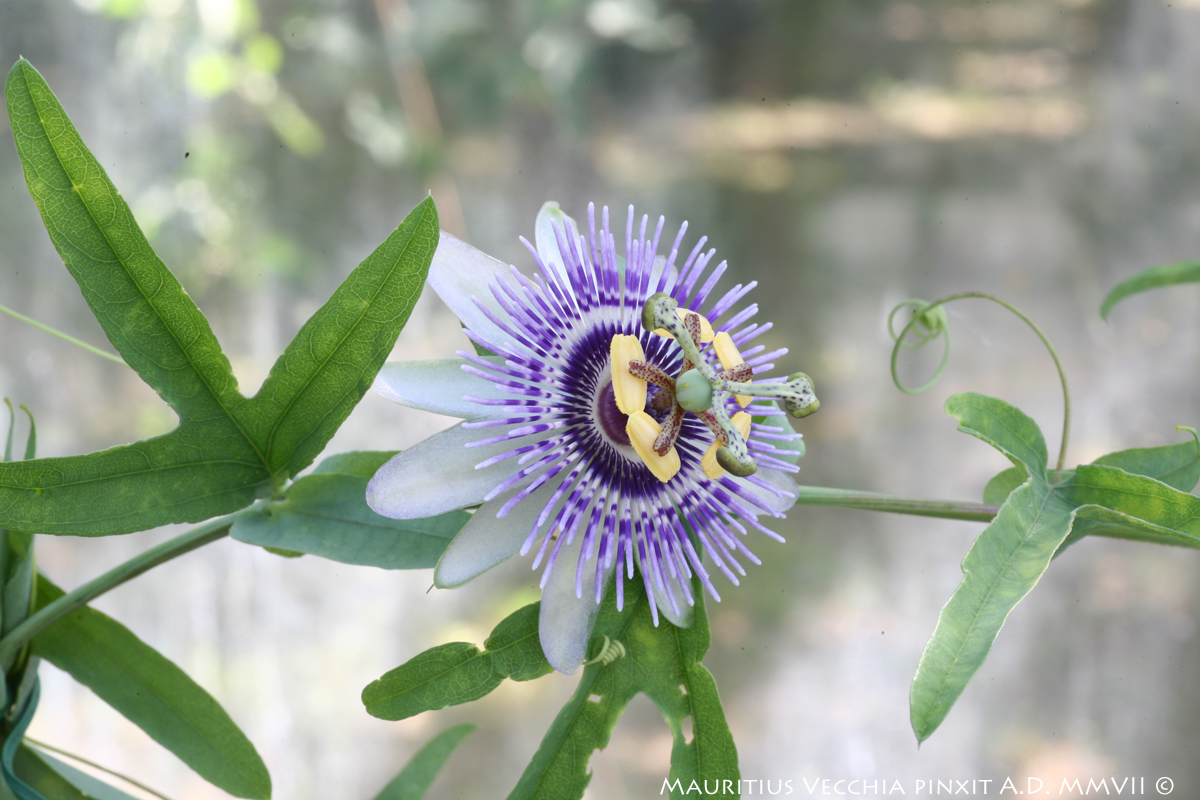
Passiflora mooreana
Hook. (1840)


SUBGENUS: passiflora
SUPERSECTION: stipulata
SECTION: granadillastrum
GEOGRAPHICAL DISTRIBUTION OR ORIGIN:
Southern Bolivia, Paraguay and northern Argentina at low elevations.
CRITICAL MINIMUM TEMPERATURE: 5 °C
IDEAL MINIMUM TEMPERATURE: 8 °C
ETYMOLOGY: Species honoured to the English botanist and gardener Thomas Moore (1821 - 1887).
DESCRIPTION:
When the flower of Passiflora mooreana opens, it creates a slightly puzzling impression. One immediately thinks, “I have seen these flowers before,” yet a hint of doubt remains. A moment’s reflection solves the small mystery. The flowers really do resemble those of the familiar Passiflora caerulea, though a few details do not match entirely. The white corolla is the same, the corona with its blue bands as well. The colours of the filaments are arranged in a similar way, even if distributed differently. Even the overall size and bearing of the flower recall caerulea.
The distinction, however, becomes clear as soon as the corona is observed more closely. In caerulea, the coloured bands are two: a dark purple one in the centre and a blue one at the tips, separated by a white zone. In Passiflora mooreana, the pattern is different. The bands become three, all blue, with a single white stripe that interrupts the series midway through the corona. Moreover, the filaments, instead of turning blue towards the ends, remain white for a large portion of their length.
Another difference that removes any remaining doubt lies in the foliage. In Passiflora caerulea the leaves are five-lobed, while in this species they are three-lobed. Caerulea is also more cold-hardy, although mooreana does not require the high temperatures demanded by most South American species.
Passiflora mooreana belongs to the subgenus Passiflora, supersection Stipulata, section Granadillastrum, the same as Passiflora caerulea. It is native to the warm-temperate and subtropical regions of South America. Records confirm its presence in Paraguay, Bolivia, and wide areas of north-eastern and north-western Argentina, where it has been documented in several provinces, including Buenos Aires, Chaco, Córdoba, Formosa, Salta, Santa Fe and Tucumán. In the latter regions, other cold-tolerant species also occur, such as Passiflora tucumanensis.
In its natural environment it favours temperate, subhumid climates with rainy summers and mild winters, tolerating moderate periods of seasonal dryness.
The plant flowers for many months in its native range, with the best period extending from spring to early autumn in the southern hemisphere. The flowers attract mainly bees, but also some moths that arrive towards evening. They readily accept pollen from other insects, a trait that encourages fruit formation.
In Italy it should be treated as an outdoor summer species and protected during the winter, even with a simple cold greenhouse. In Mediterranean and lakeside gardens it represents an excellent alternative to Passiflora caerulea, being less invasive and less prone to producing suckers. When grown in a pot, it prefers a well-drained soil enriched with humus.