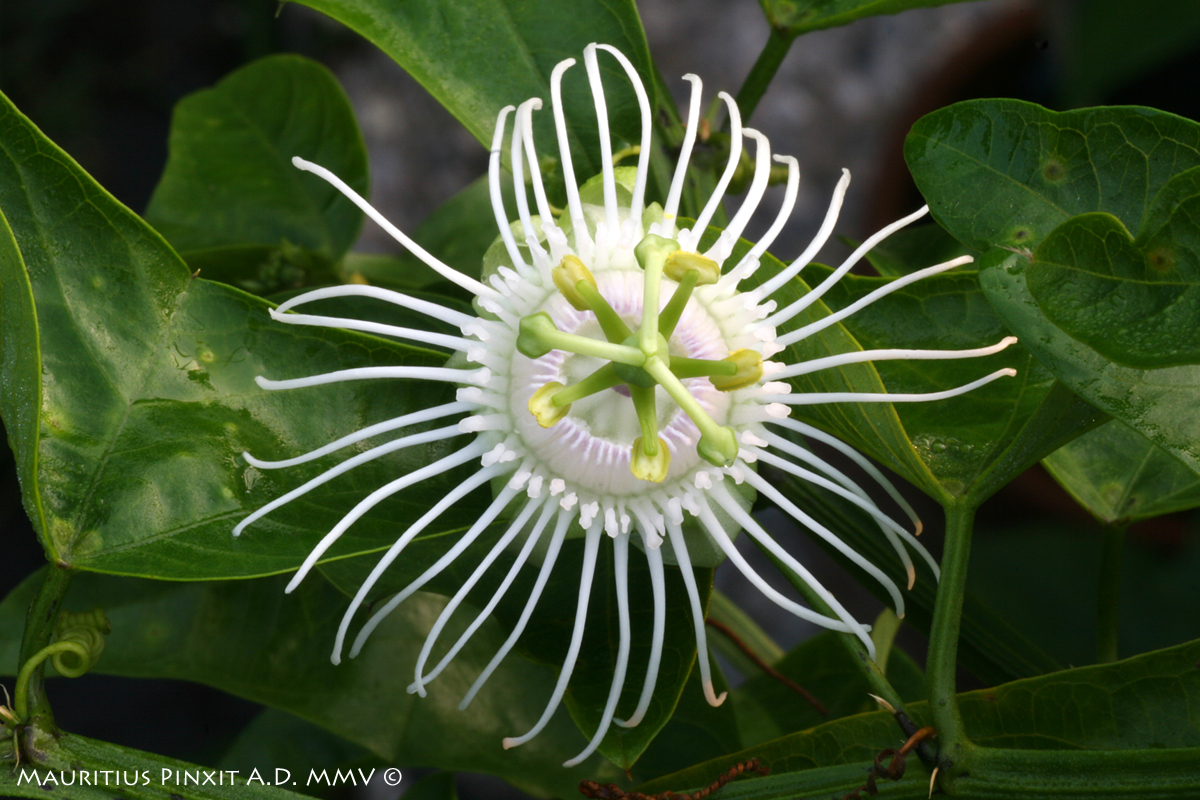
Passiflora misera
Kunth (1817)


SUBGENUS: decaloba
SUPERSECTION: decaloba
SECTION: decaloba
GEOGRAPHICAL DISTRIBUTION OR ORIGIN:
Panama and northeastern South America.
CRITICAL MINIMUM TEMPERATURE: 5 °C
IDEAL MINIMUM TEMPERATURE: 8 °C
SYNONYMS: P. discolor Link & Otto, P. laticaulis Killip, P. longilobis Hoehne, P. maximiliana Bory, P. microcarpa Mast, P. retusa Hook, P. translinearis Rusby,
ETYMOLOGY: From the Latin miser, poor, perhaps for the morphological characteristics.
NOTES: Chromosomes: 2n=12, 2n=36 (Melo et al., 2001)
DESCRIPTION:
The name of this species has always raised some questions for me. Why dwell on its simplicity, emphasising its modest appearance, its small flowers, subdued colours and slender growth, especially when compared with other members of the genus? The existence of numerous synonyms also reflects the difficulty botanists have had in distinguishing it from related or similar species.
This species is widely distributed across South America and is also found in Central America, extending throughout the northern part of the continent, except for southern Argentina and Chile, adapting to very different biomes. Such a broad distribution tells us much about the character of Passiflora misera. It is an adaptable species, capable of colonising environments ranging from forest edges to open clearings, from humid areas to regions that endure periods of drought.
The plant has a certain lightness that makes it immediately recognisable to anyone familiar with the Decaloba group. The foliage is bilobed, with slender, diverging lobes that give the plant a delicate and airy appearance. The small white flowers appear singly along the stems and follow one another continuously throughout the favourable seasons, often for much of the year. The main corona is white, and the sparse filaments curve gently towards the reflexed corolla.
Anyone who observes it with even a little attention will appreciate its refinement, its restraint, and that subtle harmony of details that clearly places it among the most distinctive members of the Passiflora family.
I have cultivated this species for years, and it has never given me any trouble. Unlike many other Passiflora species that are lost and later reintroduced, Passiflora misera remains a steady, unobtrusive presence. It adapts well to different conditions, tolerates a certain amount of stress, and grows easily even in poor soils. It should be grown in a pot and sheltered during winter, although it shows a slightly greater tolerance to cold than many of its close relatives.