Passiflora malacophylla
Mast. (1872)


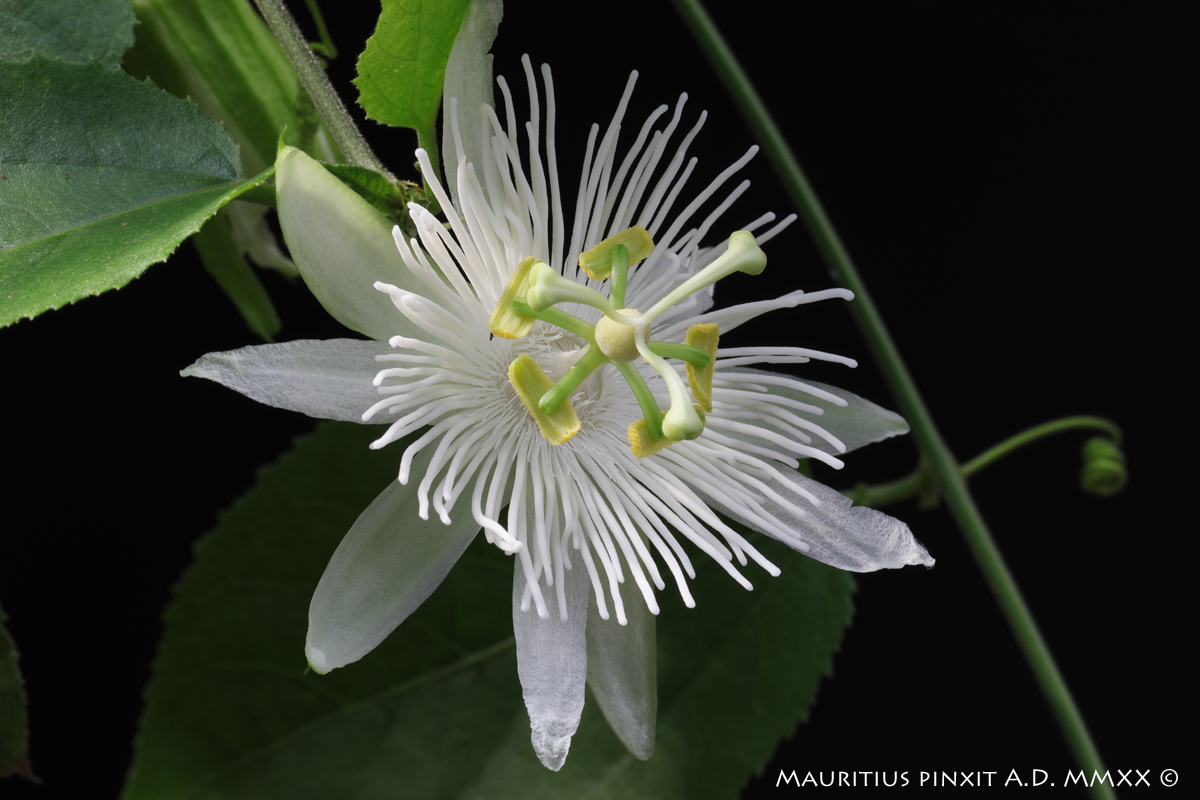
SUBGENUS: passiflora
SUPERSECTION: passiflora
SERIES: serratifoliae (cervi)
GEOGRAPHICAL DISTRIBUTION OR ORIGIN:
Central and Eastern Brazil.
CRITICAL MINIMUM TEMPERATURE: 8 °C
IDEAL MINIMUM TEMPERATURE: 12 °C
ETYMOLOGY: From the Greek μαλακός (malakos, soft, delicate) and φύλλα (fylla, leaf): with soft leaves.
NOTES: Chromosomes: 2n=18
DESCRIPTION:
This species flowers regularly and for almost the entire year in my collection. Even in winter, when it is kept in the greenhouse, it continues to produce flowers while most species enter dormancy. I value it greatly both for its delicate fragrance and for the perfection of the pure, bright and even white of its radiant flowers. It is a well-balanced plant in every respect, without excess or fragility, with neat growth and thin, soft leaves that fully justify its name.
The flowers of Passiflora malacophylla reach an average diameter of about 8 centimetres. The pure white corona, made up of numerous fine, straight filaments, forms a harmonious and precise pattern, barely covering the corolla. The scent, light yet perceptible, is most noticeable in the morning when the flowers open, and tends to fade as the day goes on.
The leaves are entire, elliptic-lanceolate, with an acute apex and a finely serrated (crenulate) margin. They are velvety to the touch and light green in colour.
It is native to the eastern and south-eastern regions of Brazil, where it grows spontaneously in the states of Bahia, Minas Gerais and Espírito Santo. Its natural habitat is the tropical rainforest, a warm environment with rainfall distributed throughout the year. The vegetation is dense and evergreen, with a constantly humid understorey and deep soils often interrupted by rocky outcrops in hilly areas. Temperatures are mild for most of the year and rarely drop below 15 °C.
This information helps to determine the minimum temperature required during winter when the plant is brought indoors. It nevertheless adapts to slightly lower values and tolerates brief drops below 10 °C without evident damage.
In most parts of Italy it is best cultivated in pots. It benefits from a regular supply of liquid fertiliser for flowering plants, applied at a low dosage but with good frequency.
In warm and humid conditions it maintains an almost continuous vegetative activity, with flowering that continues for most of the year.


