Passiflora insignis
(Mast.) Hook. f. (1873)


SUBGENUS: passiflora
SUPERSECTION: tacsonia
SECTION: insignes
GEOGRAPHICAL DISTRIBUTION OR ORIGIN:
Bolivia.
CRITICAL MINIMUM TEMPERATURE: 5 °C
IDEAL MINIMUM TEMPERATURE: 10 °C
SYNONYMS: P. callimorpha Harms.
ETYMOLOGY: From the Latin insignis, remarkable, showy, showy due to the large size of the flower.
DESCRIPTION:
I happened to see Passiflora insignis in flower only once. It was in 2004, and I was in Germany at a gathering of enthusiasts held in the nursery of Torsten Ulmer, coauthor of an important work devoted to the genus Passiflora. The journey had been rather long, made with my own car and in the company of a few friends. On the way back we allowed ourselves a detour towards Schaffhausen, on the border between Germany and Switzerland, to visit the nursery of Franz Dülli. That was where I noticed it. In a large pot, beneath a wide berceau, a specimen of this species was climbing, flowering and intertwined with other passion flowers grown in the same space. I had noticed the large trilobed leaves, the stems and the vegetative parts covered with a dense tomentum, a feature evident even from a distance.
Over the years I tried several times to cultivate it, without satisfactory results. The species assigned to the Supersection Tacsonia have never been accommodating with me. They require constant attention to both minimum and maximum temperatures, and the substrate must be prepared with care, since the roots are very sensitive to nematodes and fungal infections. These are demands that do not forgive carelessness, especially when one attempts to grow them in a climate that resembles very little their mountain environments of origin and when the roots encounter unfamiliar fungal organisms against which they have no defences.
In its natural range Passiflora insignis grows in the humid tropical forests of northern Bolivia, along the eastern slopes of the Cordillera, particularly in the Madidi region between the departments of La Paz and Beni. The biotope consists of montane rainforests with a warm and humid climate, regular rainfall throughout the year, soils rich in organic matter and altitudes that generally fall between 1300 and 3000 metres.
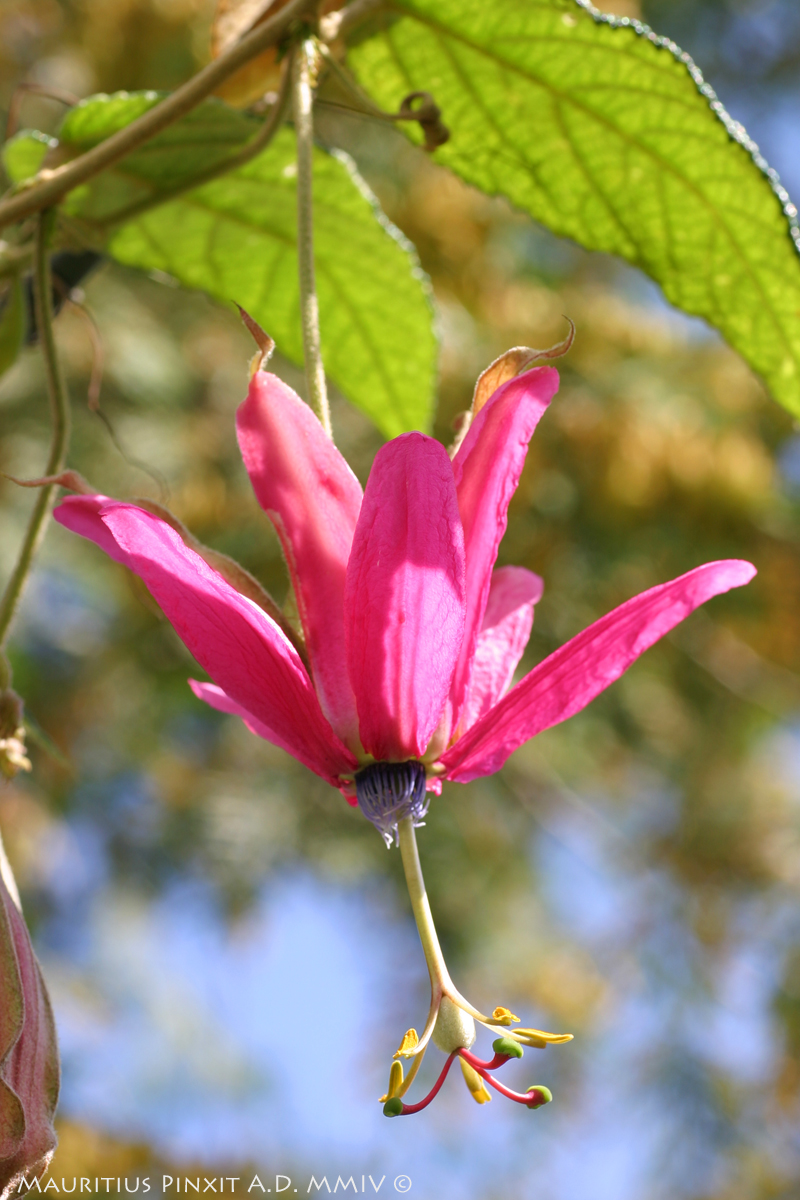
The flower of Passiflora insignis is among the largest in the Supersection Tacsonia and can reach 17 centimetres in diameter, a size that clearly explains the origin of its name. It is a pendulous and broad flower, with a corolla formed by long sepals and petals arranged in a radial pattern, slightly and irregularly reflexed. The colour is an intense and uniform pink, which stands out especially when the flower is fully open.
The calyx measures about 4 centimetres and is shorter than that of some related species. It has an elongated tube, well marked costae and a tomentose surface that remains visible at the base of the corolla even when the flower is completely open.
The corona is reduced and consists of a single series of short, dark filaments gathered at the base of the corolla. The contrast between their violet colour and the bright pink of the sepals and petals gives the flower a clear and easily recognisable character within the group of tacsonias.
Overall the flower appears bright and well defined in its contrasts, a balance between the saturated pink of the corolla and the dark violet of the corona, with the pendulous habit contributing to the distinctive profile of the species.
The pollination of Passiflora insignis follows the typical patterns of the Andean tacsonias, a group that has developed a very close relationship with hummingbirds. The general shape of the flower suggests this clearly: a broad and pendulous perianth that allows the frontal approach of a small bird in hovering flight. The colours also follow the classic pattern, with a vivid pink lacking nectar guides visible to insects and a reduced corona that leaves free access to the nectar.
The position of the flower, always pendulous, is another important indication. In tacsonias this orientation is almost always associated with ornithophilous pollination: the hummingbird can approach without obstacles, insert its beak into the throat of the flower and reach the base of the androgynophore where the nectar is concentrated. During the movement the head and the front of the beak inevitably touch the anthers and the stigmas, transferring pollen from one flower to another.
For these reasons Passiflora insignis remains a rare presence in collections, a demanding species that requires conditions very close to those of its native environment, including fresh summers. Those who attempt to cultivate it must accept slow growth and a few setbacks, but also the satisfaction of seeing a flower that clearly reflects the character of the montane tacsonias, with its broad corolla, pendulous habit and contrasts of pink and violet.
