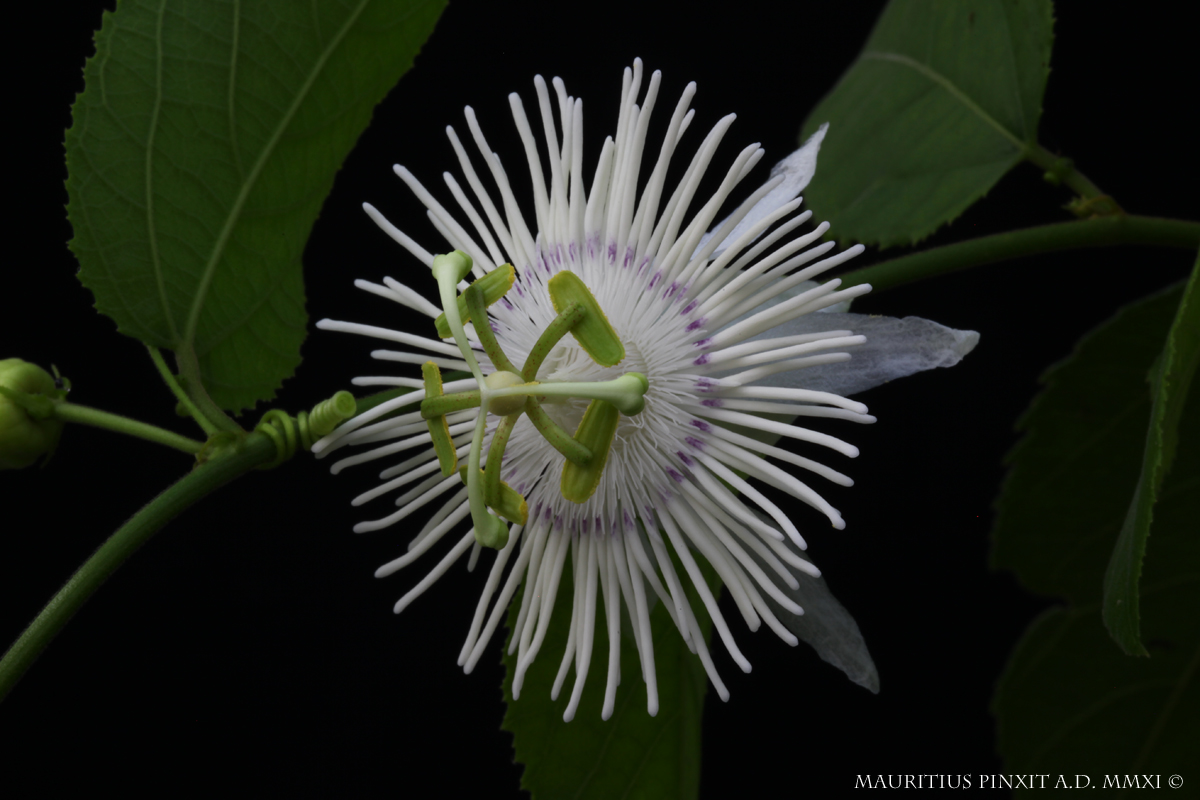
In the open flower the corona displays a very regular arrangement, with long, slender and perfectly straight filaments distributed evenly all around the centre. The white remains uniform along their length, while the violet ring placed halfway provides the only visible contrast. The corolla, formed by petals and sepals of the same pure white, confirms this essential structure and gives the flower a compact profile.
The overall proportions remain balanced. The corona does not exceed the corolla in size but follows its diameter and stays aligned with the margin created by petals and sepals. The two structures therefore lie on the same plane and form an orderly, clean pattern. This restrained layout, based on a few precise elements, makes Passiflora farneyi recognisable even among other white passion flowers. There is in fact another species very similar in flower structure and taxonomic placement, also belonging to the supersection Passiflora, series Passiflora. Its flower is practically identical, but completely white and lacking the violet ring. It is Passiflora malacophylla, from which Passiflora farneyi is distinguished precisely by the presence of this ring. Both species are scented.
Another similarity between Passiflora farneyi and Passiflora malacophylla concerns the leaves. They are indeed very alike. Both have a lanceolate blade, a petiole with a pair of glands inserted in the same position and a serrated margin that confirms their morphological affinity.
Passiflora farneyi is a coastal species endemic to south eastern Brazil, so far known only from the state of Rio de Janeiro, where it grows in remnants of restinga in the Região dos Lagos, on poor, sandy and very well drained soils at the margins of the Atlantic forest. It inhabits low, warm and well ventilated environments that are now fragmented and threatened by urban expansion.
During a journey to Brazil we ventured into a thicket where this species had been recorded, but we were unable to find it. We did, however, enjoy a small botanical consolation, since in the same place we happened to observe a very interesting species assigned to the subgenus Astrophea that we were not able to identify.
In cultivation this species is easy. It adapts well to container growing, provided the pot is brought indoors for the winter period. Attention must be paid to minimum temperatures, which cannot be very low. The flowers appear in succession from late spring to early September in northern Italy. It has no particular requirements regarding the potting mix. The only precaution is to water sparingly and only when truly necessary.
Passiflora farneyi combines elegance and restraint with a natural predisposition to cultivation. This combination makes it a valuable presence for anyone wishing to gain a better understanding of the group of white passion flowers. It has been part of my collection for many years.