Passiflora carajasensis
Koch & Ilkiu-Borges (2021)


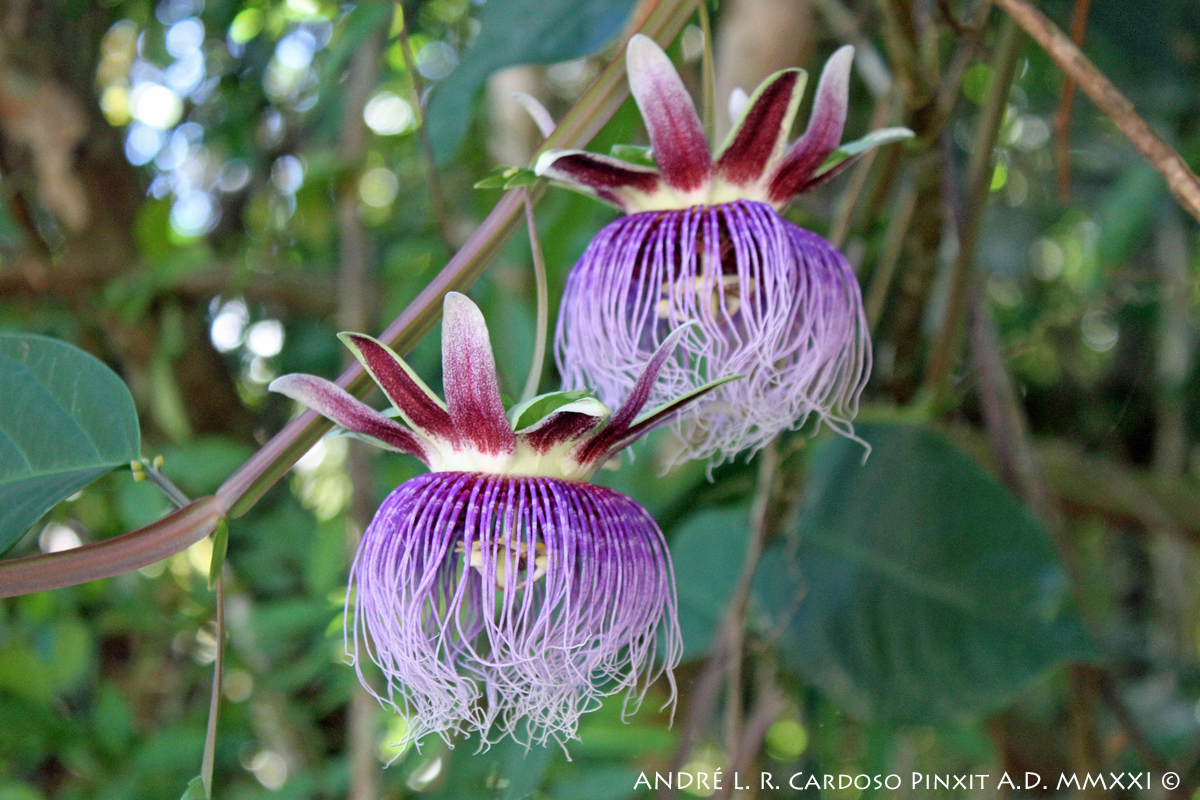
SUBGENUS: passiflora
SUPERSECTION: laurifolia
SERIES: quadrangulares
DESCRIPTION:
Passiflora carajasensis is a Brazilian species described in 2021 on the basis of material collected in the Serra dos Carajás region, in the state of Pará. This is an area of considerable environmental complexity, located within the Amazonian domain but marked by strong ecological discontinuities. Here, ombrophilous forest alternates with open formations, iron rich rocky outcrops and areas of secondary vegetation, giving rise to a mosaic of selective and fragmented habitats.
The species grows in this transitional setting within the Amazon biome, in warm and humid environments that are not necessarily associated with dense primary forest. The known collecting sites are located at elevations between 500 and 700 metres, in marginal areas of forest cover where the vegetation is lower, discontinuous and often affected by disturbance. In these conditions, the liana readily finds support on shrubs and medium sized trees.
From a systematic point of view, Passiflora carajasensis belongs to the supersection Laurifolia and to the Series Quadrangulares, which brings together species characterised by robust lianas, angular or winged stems and large fruits. Its placement within this Series is consistent with the overall set of vegetative and reproductive characters observed, and comparison with related species played a central role in the definition of the new taxon.
In terms of classification, Passiflora carajasensis is closely related to Passiflora longifilamentosa and Passiflora trialata, species with which it shares several general features. The differences observed, both in the vegetative parts and in the flower, are nevertheless sufficient to justify its recognition as a distinct species within the Series Quadrangulares.
The plant presents itself as a glabrous liana with orderly growth and compact vegetation. The leaves are simple and entire, with a leathery blade and a uniform appearance, contributing to an overall restrained habit with no particular ornamental features at the vegetative level. It is the flower that represents the main element of morphological interest, following a pattern typical of the series, with a well developed corolla and a corona articulated into several series of filaments.
The flower is pendent and fully conforms to the structural model of the Series Quadrangulares. The fruit also follows this pattern in terms of size and shape, reinforcing the systematic placement of the species. Available observations indicate a flowering period spread over several times of the year, with flowers recorded in July, September and December, while fruiting has been documented in February, March and July.
Passiflora carajasensis is currently known from only four localities within the Floresta Nacional de Carajás, all concentrated in the Serra dos Carajás. Older collections indicate that some of the original sites have been destroyed or profoundly altered by mining activities, while more recent records come from residual areas of ombrophilous forest close to human settlements. On the basis of its extremely limited area of occupancy and the fragmentation of its habitat, the species has been assessed as endangered according to IUCN criteria, with a direct threat linked to the expansion of mining activities.
Knowledge of Passiflora carajasensis remains almost exclusively tied to its natural area of origin and to the material collected at the time of its description, and the species is not known to be in cultivation nor documented in European collections. Given its rarity and the risk of extinction it faces, its future introduction into botanical gardens and among specialist collectors would be desirable.
Image
courtesy of André L. R. Cardoso ©