Passiflora crenata is a species described by Feuillet and Cremers in 1984 and belonging to the flora of French Guiana, where it was first discovered and collected. Its taxonomic status is still a matter of debate, as some scholars consider it a synonym of Passiflora riparia Mart., described as early as 1872.
Other authors defend its distinction on the basis of subtle but consistent morphological differences, such as the shape and texture of the bracts or the colour of the inner parts of the flower. It is not for me to take a side in these disputes: I describe it here as I have always known it and as I have seen it during my travels in French Guiana.
It is nonetheless a species belonging to the subgenus Passiflora, supersection Laurifolia and section Laurifoliae, that large group of tropical lianas with entire, glossy and leathery or slightly lobed leaves, pendulous flowers and the typical oval fruits that have given Passiflora laurifolia its name.
In its natural habitat it grows in the humid and well-lit areas of the tropical forest, often along watercourses or at the edges of woods, where it climbs over the surrounding vegetation. It is a vigorous liana, with a tidy habit and leathery, dark green foliage that, in the stable conditions of French Guiana, grows continuously for most of the year.
The leaves are entire, ovate or slightly elliptical in shape, with a pointed tip and leathery texture, glossy on the upper surface and lighter green beneath. On the petiole, in its first half, there is a single pair of clearly visible, slightly elongated glands.
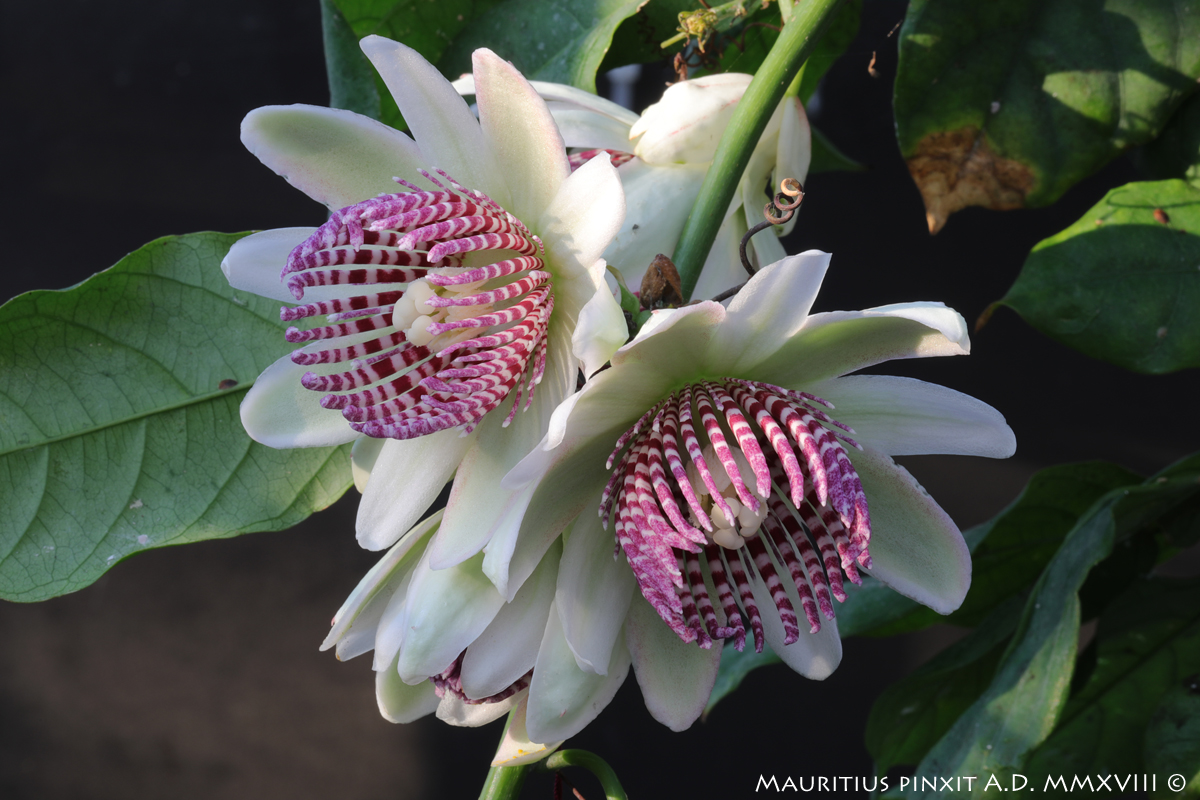
The flowers are solitary and borne on short, pendulous peduncles. Sepals and petals are white or cream, sometimes with faint greenish tints on the outer surface. The corona is composed of numerous filaments arranged in concentric series, with alternating bands of white and purple that highlight its orderly and harmonious structure.
The flower is about seven centimetres in diameter and gives off a sweet, slightly fruity scent perceptible during daylight hours, indicating that its main pollinators are bees and other diurnal insects.
The fruit is oval or almost spherical, yellow-orange when ripe, with a smooth, glossy skin dotted with lighter spots. The pulp is whitish, juicy and pleasant; although it has no commercial value, it is consumed locally.
In cultivation it behaves like other tropical Passiflora species with entire leaves. It prefers filtered light, temperatures between 18 and 28 °C and consistently high humidity without waterlogging. It adapts well to warm greenhouses and sheltered terraces, provided the substrate is loose and rich in organic matter. Multiplication can be done by seed or semi-woody cuttings, which root easily if kept in a moist and well-ventilated environment. Flowers often appear in pairs or small clusters.
Passiflora crenata represents an interesting link within the complex of the Laurifoliae group. Its taxonomic placement is not yet completely settled, but it remains a noteworthy species, elegant in its flowering and endowed with the understated beauty shared by many Amazonian Passiflora. Even though the boundaries with Passiflora riparia are not entirely clear, it deserves a prominent place in collections as a testament to a natural diversity still under active revision.